
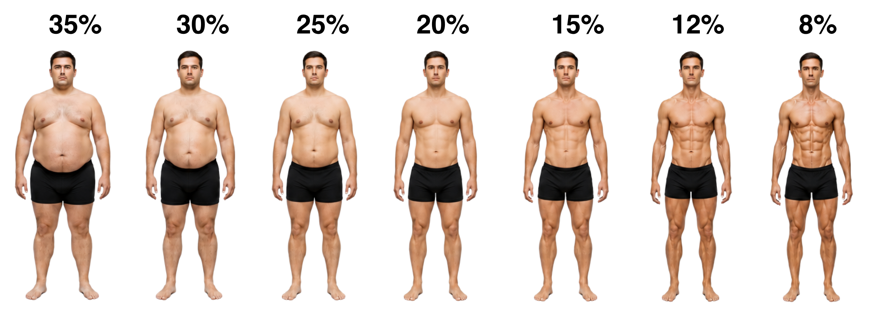
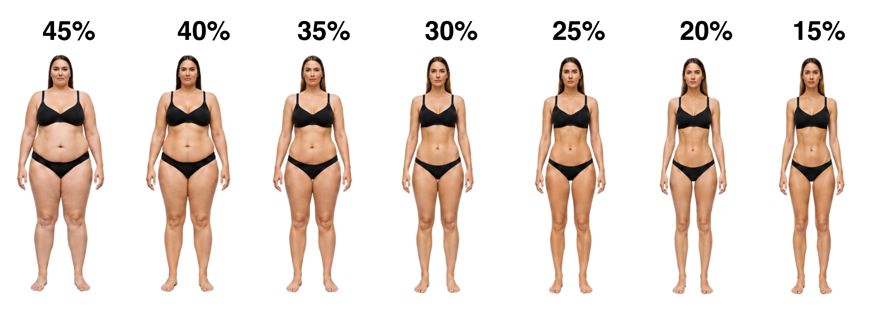
Understanding Body Fat Percentage
Body fat percentage is the proportion of your total body weight that comes from fat.
For example, if someone weighs 80 kg and has a body-fat percentage of 20%, approximately 16 kg of their body weight would be fat mass, while the remaining 64 kg would consist of lean mass such as muscle, water, bone, organs, and other tissues.
Body fat is not inherently bad. Your body needs a certain amount of fat to function properly. Fat provides energy, helps protect organs, supports cell membranes, and plays an important role in hormone production and the absorption of certain vitamins.
However, having either too little or too much body fat can be associated with health problems. This is why body-fat percentage can be a useful measurement when assessing body composition, fitness, and changes in weight over time.
What Is Body Fat Percentage?
Your body weight is made up of several different components. These can broadly be divided into:
- Fat massThe amount of fat stored in your body.
- Lean massEverything that is not fat, including muscle, bones, organs, water, and other tissues.
Body-fat percentage tells you what proportion of your total body weight is fat. The basic relationship is:
For example, if you weigh 70 kg and have 14 kg of fat:
Your body-fat percentage therefore gives you information about body composition, rather than simply telling you how much you weigh.
Why Is Body Fat Important?
Body fat performs several important functions. Some body fat is stored as essential fat, which your body needs for normal physiological functions. Additional fat can be stored as an energy reserve.
Body fat also helps:
- Store energy
- Protect internal organs
- Insulate the body
- Support cell structure
- Assist hormone-related functions
- Absorb fat-soluble vitamins such as A, D, E, and K
The goal is therefore not to eliminate body fat. Instead, maintaining an appropriate amount of body fat is part of maintaining good health and normal body function.
Essential Fat vs Stored Body Fat
Not all body fat serves exactly the same purpose.
Essential body fat is the minimum amount of fat required for normal physiological functioning. It is found in areas such as the brain, nervous system, bone marrow, organs, and cell membranes.
Stored body fat is additional fat stored primarily in adipose tissue. Some stored fat can be used as an energy reserve.
The amount of essential fat differs between men and women, which is one reason healthy body-fat ranges are generally different for the two sexes. Trying to reduce body fat to extremely low levels is not necessarily healthier and can interfere with normal physiological functions.
What Is a Healthy Body Fat Percentage?
There is no single body-fat percentage that is ideal for everyone. Healthy levels can vary based on factors such as:
- Sex
- Age
- Genetics
- Activity level
- Training history
- Hormonal status
- Individual body composition
Body-fat classifications are therefore best treated as general reference ranges, rather than exact targets that everyone should try to reach. For example, athletes and highly trained individuals may have lower body-fat levels than the general population, while older adults may naturally carry somewhat more body fat.
A reasonable target depends on your individual circumstances and goals. Someone focused primarily on general health may have a different appropriate body-fat level than a competitive athlete, and your ideal range can change with age and training experience. Rather than chasing a specific number, focus on maintaining a body composition that supports:
- Good health
- Adequate energy
- Physical performance
- Recovery
- Normal physiological function
- A sustainable lifestyle
It is also important to remember that different methods of measuring body fat can produce different results.
Body Fat Percentage Ranges
General reference charts often provide different body-fat ranges for men and women. The calculator above uses a widely used set of categories from the American Council on Exercise (ACE):
| Category | Men | Women |
|---|---|---|
| Essential fat | 2–5% | 10–13% |
| Athletes | 6–13% | 14–20% |
| Fitness | 14–17% | 21–24% |
| Average | 18–24% | 25–31% |
| Higher body fat | 25%+ | 32%+ |
These values should be considered general guidelines rather than strict medical cutoffs. The essential fat range is the minimum your body needs, not a goal. Different organizations and research sources may use different classification systems, so your result should not be interpreted as an exact measure of your health.
How Does This Body Fat Calculator Work?
This calculator uses the US Navy tape method, a circumference-based formula developed by researchers at the US Naval Health Research Center. It estimates body fat from measurements around specific parts of the body, combined with your height and sex:
- Men: height, neck, and waist
- Women: height, neck, waist, and hips
Your weight is not part of the formula. It is only used to split your result into fat mass and lean mass in kilograms. Your age is used to let you know if the adult ranges may not apply.
With all measurements in centimetres, the formulas are:
It is important to understand that this is an estimate, not a direct measurement of your body's fat content.
How to Measure Yourself
How you take your measurements affects the result more than anything else. A few centimetres in the wrong place can move your estimate by several percentage points.
- NeckMeasure just below the Adam's apple (larynx), with the tape sloping slightly downward at the front.
- Waist (men)Measure level with your belly button. Stand relaxed and measure after a normal breath out, without pulling your stomach in.
- Waist (women)Measure at the narrowest part of your waist, usually a little above the belly button.
- Hips (women)Measure around the widest part of your bottom, with your feet together.
Use a soft, non-stretch tape on bare skin. Keep it level and snug without squeezing. Measure each spot two or three times and use the average. If you are tracking changes, measure at the same time of day, ideally in the morning before eating.
Body Fat Percentage vs BMI
Body-fat percentage and BMI are related to body composition, but they measure different things. BMI compares your weight with your height. Body-fat percentage estimates how much of your body weight is fat.
This distinction can be important. For example, a muscular person may have a relatively high BMI because muscle contributes to body weight, while still having a relatively low body-fat percentage. Conversely, someone can have a BMI within the healthy range while carrying a relatively high proportion of body fat.
Research also suggests that South Asians tend to carry more body fat than people of European descent at the same BMI. This is one reason our BMI calculator offers lower Asian / Indian cut-offs.
This is one reason body-fat percentage can provide additional information that BMI cannot. However, body-fat percentage estimates also have limitations and should not be treated as perfectly accurate.
How Accurate Is a Body Fat Calculator?
The accuracy of a body-fat calculator depends on the method used and the quality of the measurements entered. A calculator that uses body measurements is estimating body composition indirectly. It does not actually measure the amount of fat inside your body.
Studies comparing the Navy method with laboratory methods typically find it lands within about 3 to 4 percentage points for most people. That is why the calculator shows your result as a whole number with a likely range, rather than a precise figure.
Your result can be affected by:
- Incorrect measurements
- Where the measuring tape is placed
- Differences in body shape
- Hydration status
- Individual differences in fat distribution
- The formula used by the calculator
- Measurement technique
Tape methods can also be less accurate for very muscular people. A thick, muscular neck, for example, can make the estimate come out lower than your true body fat.
For this reason, you should not assume that a result such as 18.7% is accurate to the nearest decimal place. If the calculator estimates that you have 20% body fat, the important takeaway is not that your true body-fat percentage must be exactly 20%. Use the result as an approximate reference point. If you use the same method consistently, changes in the estimate can still be useful for tracking long-term trends, even if the absolute number is not perfectly accurate.
Different Ways to Measure Body Fat
There are several methods for estimating or measuring body composition.
Circumference measurements
Tape measurements around areas such as the waist and neck can be used with mathematical formulas to estimate body-fat percentage. This is the approach used by the calculator above.
Advantages
- Inexpensive
- Easy to perform
- Requires minimal equipment
- Convenient for tracking changes over time
Limitations
- Depends on accurate measurements
- Results can vary with technique
- Provides an estimate rather than a direct measurement
Skinfold calipers
Skinfold measurements use calipers to measure the thickness of folds of skin and underlying subcutaneous fat at specific locations. The measurements are then entered into a formula to estimate body-fat percentage. Accuracy depends heavily on the skill of the person taking the measurements and the formula being used.
Bioelectrical impedance analysis (BIA)
BIA scales and devices send a small electrical current through the body and use the resulting measurements to estimate body composition. These devices are convenient and widely available, but their results can be affected by factors such as:
- Hydration
- Food intake
- Exercise
- Body temperature
- Time of day
As a result, BIA readings can fluctuate even when your actual body composition has not changed significantly.
DEXA
DEXA (Dual-Energy X-ray Absorptiometry) can provide detailed information about bone mineral content, lean tissue, and fat tissue. It is generally more sophisticated than consumer body-fat scales, but it is more expensive and requires specialized equipment. Even DEXA should not be considered an absolutely perfect measurement of body-fat percentage.
Other laboratory and clinical methods
Other techniques, such as air-displacement plethysmography and hydrostatic weighing, can also be used to assess body composition. These methods are generally less accessible for everyday use but can provide useful estimates under controlled conditions.
Why Can Body Fat Measurements Change From Day to Day?
Your actual body-fat mass does not normally change dramatically from one day to the next. However, your measured body-fat percentage can fluctuate. Changes in the following can influence body weight and certain body-composition measurements:
- Hydration
- Food and fluid intake
- Exercise
- Glycogen levels
- Sodium intake
- Bowel contents
- Measurement conditions
This is particularly noticeable with BIA devices. Comparing measurements taken under different conditions can make your progress appear more variable than it really is, so for tracking purposes it is often more useful to measure yourself under similar conditions each time.
How to Track Body Fat Over Time
If your goal is fat loss or improving body composition, looking at trends is generally more useful than focusing on a single measurement. For example, instead of worrying about whether your body fat changed from 18% to 17.5% in one week, consider whether the overall trend is moving in the desired direction over several weeks or months.
Try to keep your measurement conditions consistent. You might measure:
- At approximately the same time of day
- Using the same equipment
- Using the same measurement technique
- Under similar hydration conditions
- At consistent intervals
You can also combine body-fat estimates with other measurements such as body weight, waist circumference, progress photos, strength, and fitness performance.
Body Fat and Weight Loss
When you lose weight, the change can come from different components of your body. Ideally, when someone is trying to lose body fat, the goal is to reduce fat mass while preserving as much lean mass as reasonably possible.
Several factors can help support this process, including:
- Maintaining an appropriate calorie deficit
- Consuming sufficient protein
- Performing resistance training
- Getting adequate sleep
- Staying physically active
- Following a sustainable nutrition plan
The rate of progress can vary considerably between individuals. Rapid changes on the scale do not necessarily represent equivalent changes in body fat because body water and glycogen can also change.
Body Fat and Muscle Gain
If your goal is to build muscle, your body weight may increase even if your body-fat percentage stays similar or decreases. For example, someone could gain muscle while losing some fat, resulting in relatively little change in total body weight. This is sometimes referred to as body recomposition.
For this reason, body weight alone may not fully capture changes in physique. Tracking multiple measurements can provide a better understanding of what is happening.
Can You Have Too Little Body Fat?
Yes. Although reducing body fat is a common fitness goal, lower body fat is not automatically better. Extremely low body-fat levels can be difficult to maintain and may be associated with problems such as:
- Reduced energy availability
- Hormonal disturbances
- Poor recovery
- Reduced athletic performance
- Changes in reproductive function
- Increased risk of certain nutritional deficiencies
The amount of body fat required for good health varies between individuals. A fitness-focused goal should therefore be based on health, performance, body composition, and sustainability, rather than trying to achieve the lowest possible number.
Can You Have a Healthy Body Fat Percentage but Poor Health?
Yes. Body-fat percentage is only one aspect of health. Someone can have a relatively low body-fat percentage while still having an inadequate diet, poor cardiovascular fitness, insufficient sleep, or other health concerns.
Similarly, someone with a higher body-fat percentage can still have good fitness levels and healthy lifestyle habits. Body composition is important, but it should be considered alongside other indicators of health.
Body Fat Distribution Matters
Where your body stores fat can also be important. Fat stored around the abdomen, particularly visceral fat surrounding internal organs, is more strongly associated with metabolic health risks than some forms of fat stored elsewhere in the body.
Two people with the same body-fat percentage can therefore have different patterns of fat distribution. This is another reason why body-fat percentage alone cannot provide a complete picture of health. Measurements such as waist circumference can provide additional context.
The Bottom Line
Body-fat percentage tells you approximately what proportion of your body weight is fat. Unlike BMI, it provides information about body composition, which can make it useful when tracking fat loss, muscle gain, and changes in physique.
However, body-fat percentage is not a perfect measurement. Calculator-based estimates can be affected by the formula used, measurement technique, hydration, body shape, and other factors.
For the most useful picture of your progress, consider your estimated body-fat percentage alongside body weight, waist circumference, fitness, strength, nutrition, and overall health.
Most importantly, don't assume that lower body fat is always better. The goal should be to maintain a level of body fat that supports health, performance, normal physiological function, and a sustainable lifestyle.
Use your body-fat percentage as a useful data point, not a definition of your health or worth.